Update for Maria Marschall

From my Heraldry Buddy, for @sca-nerd


Some Early Middle High German Bynames
with Emphasis on Names from the Bavarian Dialect Area

[Link]

MARSCHALC: ‘a farrier, a groom’, later a high official; NHG Marschall.

Wernherus probus Marschalcus 1233
Heythenricus qui dicitur Marescalcus 1172 (MARSCHALL)

Medieval German Given Names from Silesia: Women’s Names [Link]

Marie   1   1346

(Guys, you know I’m not a herald right? I’m just a librarian. <3)

scareferencedesk:

skraddaren-elef:

Min Jumbles bringeth all the peasants to the yard.
And they’re like ‘please giveth, for I am starving’
And I was like bitch, no, because I ate ‘em all already.

Seriously, through. I did. These never even made it into the cooling rack (except for the few that were artfully assembled for this photo)

Jumbles (jambals, or any of the other five hundred spellings thereof) were supposedly created around 600 bc by a monk, but there are various other recipes that are more or less the same documented regularly from the 1400’s and onward.

This is really the MVP of medieval cookie recipes. Alone, it can be used to make four different types of cookies, and if you add other ingredients and spices, the combinations are endless.

I used a modern recipe and altered it to use medieval ingredients by switching out the refined sugar for honey

Jambals:

2 cups sifted flour
1 tbsp honey
2 tbsp cream (or milk)
1 stick butter (softened but not mushy)
2 egg yolks
¼ tsp salt
(Optional anis seeds)

Mixture flour and powdered sugar for rolling

Mix dry ingredients together, then add wet ingredients and mix together with your hands until it feels like play doh. Chill for at least half an hour (or don’t, I’m not the boss of you and we all got places to be)

Preheat to 350f and prepare baking sheet with parchment paper.

For sugar cookies:
Roll out and cut out shapes as you would normal cookies, or drop as spoonfuls onto baking sheet

For jambals:
Take small amounts and roll out into thin squiggly logs, then make fun shapes like knots and pretzels.

Bake 12 minutes on top rack until lightly golden brown

Reblogging because you know I am totally going to make these tomorrow and tell you all about it.

My jambals brought no gentles to the yard. I think perhaps because I used a mixture of whole wheat and bread flour (which is what we have in the house). I think maybe cake flour would work better, and milk instead of heavy cream.

skraddaren-elef:

I have three days to make this for the known world costuming symposium, so if anyone has tips on how to even begin with that hat, please let me know, I’m screaming inside.

Thanks for the heads up, @sca-nerd​!

It appears to be a Cranach gown, which gives us a starting point. More specifically, it is from a 1546 manuscript titled 

The Saxon studbook: Collection of portraits of Saxon princes, with rhymed text; from the period between 1500 – 1546. (

Mscr.Dresd.R.3) [Link]

I found a page from What People Wore When:

A Complete Illustrated History of Costume from Ancient Times to the Nineteenth Century for Every Level of Society that shows a similar headdress and has a brief description: [Link]

Could it be a decorated wulsthaube? [Tutorial Link]

Maybe a stuchlein? [Tutorial Link]

Or maybe a combination of the two, with the outer stuchlein decorated?

OKAY! So, I have tried to do some research on my own for a name so that I wouldn’t be obnoxious to Heralds when I was ready, but I am hoping that you can give me some other assistance. I am going for 13th Century German and the name would be Marie Marschall of Seareach (because I’m original like that). I found documentation for Marschall, but I’m not sure it is one the Heralds will accept. Do you have any resources or direction for me?

I consulted with a Herald Buddy about Marschall (because everything else should be fine – Maria is well documented and SCA groups as locative bynames are cool) and found some things.

First of all “Marschall” has been registered before, so we have that documentation from the Online System of Commentary and Response:

<Marschall> – R&W, p. 300, lists a <John Marschal> in 1296 and a <Rainald le mareschal> in 1140. “Surnames in 15th Century York”, URL:http://heraldry.sca.org/heraldry/laurel/names/york15/surnames-alphabetical.htm, lists Mareshall and Marshall. “An Index to the 1296 Lay Subsidy Rolls for Rutland, England”, under the Bynames section, URL:http://heraldry.sca.org/heraldry/laurel/names/Rutland/bynamesalphabetically.htm, lists Mareschall. Based on these examples, we believe <Marschall> to be a reasonable spelling variant. 

Unfortunately, this documents the name to Germany, not England, and German and English aren’t compatible languages.

Truth is, Maria Marschall of Seareach is totally documentable for England. I can find some Marschalls in Germany via FamilySearch, but they’re all super late period. Like, born-in-1599-late-period.

Recommendation from Herald-Buddy? register it as English and play German. 😉

(Herald Buddy blogs over here: [Link] You should go read it. <3)

skraddaren-elef:

Min Jumbles bringeth all the peasants to the yard.
And they’re like ‘please giveth, for I am starving’
And I was like bitch, no, because I ate ‘em all already.

Seriously, through. I did. These never even made it into the cooling rack (except for the few that were artfully assembled for this photo)

Jumbles (jambals, or any of the other five hundred spellings thereof) were supposedly created around 600 bc by a monk, but there are various other recipes that are more or less the same documented regularly from the 1400’s and onward.

This is really the MVP of medieval cookie recipes. Alone, it can be used to make four different types of cookies, and if you add other ingredients and spices, the combinations are endless.

I used a modern recipe and altered it to use medieval ingredients by switching out the refined sugar for honey

Jambals:

2 cups sifted flour
1 tbsp honey
2 tbsp cream (or milk)
1 stick butter (softened but not mushy)
2 egg yolks
¼ tsp salt
(Optional anis seeds)

Mixture flour and powdered sugar for rolling

Mix dry ingredients together, then add wet ingredients and mix together with your hands until it feels like play doh. Chill for at least half an hour (or don’t, I’m not the boss of you and we all got places to be)

Preheat to 350f and prepare baking sheet with parchment paper.

For sugar cookies:
Roll out and cut out shapes as you would normal cookies, or drop as spoonfuls onto baking sheet

For jambals:
Take small amounts and roll out into thin squiggly logs, then make fun shapes like knots and pretzels.

Bake 12 minutes on top rack until lightly golden brown

Reblogging because you know I am totally going to make these tomorrow and tell you all about it.

manuscriptjourneys:

Anaphora of Mary (Mass book), St. Michael standing on the Devil, Walters Manuscript W.829, fol. 36r by Walters Art Museum

Via Flickr:

This mass book, containing one of about twenty anaphoras of the Church, was made for Wäldä Mädḫǝn between 1929 and 1942 (that is, when Yoḥannǝs or John was Patriarch of Alexandris, 1928-1942, and Qerǝlos or Cyril was the metropolitan of Ethiopia, 1929-1950). It was written by the scribe Wändǝmmu Gashaw (whose baptismal name was Gäbra Maryam) of Däbrä Libanos monastery, just north of Addis Ababba, Ethiopia. Written in Gǝ‛ǝz, the traditional liturgical language of the Ethiopian Orthodox Church, the manuscript contains the Anaphora of Mary ascribed to Cyriacus, bishop of the city of Bahnasa, in Upper Egypt. There is a richly colored image of the Virgin and Child on the blank folio before the text, and the manuscript ends with a depiction of St. Michael conquering the Devil. Both illuminations were painted on reused text pages, which were added much later to give value to the manuscript. The late date of this work is a testimony to the remarkable continuation of the medieval manuscript tradition into the modern era in Ethiopia.

Hello! I was wondering if you might be able to help with some name documentation. I’m an Anglo-Saxon from the Kingdom of Mercia in 910 AD, and the name I want to go with is Hardwin Godricsson. Thank you in advance!!

Hi, @spunky-punk-raven​!

Hardwin was the harder of these (har har) to find, at least within 100 years of your 910 AD date.

There wasn’t an entry for it in St. Gabriel, which is my go-to source for name stuff, but they do point to this nifty resource for Anglo Saxon names: the PASE Database, part of the Prosopography of Anglo-Saxon England.

A database of individuals mentioned in pre-Conquest English documents. Alphabetized by modern standard form; the “recorded forms” heading gives original spellings. The database is also indexed by status, possessions, occupations, relationships, and more. This database replaces an olderlist of Anglo-Saxon people recorded in selected reference works.

When searching PASE for Hardwin using PASE – 1066 seems to be the earliest, though there are some alternative spellings in the Domesday source.

PASE resource’s results for Godirc: earliest here is 970.

Hardwin has been registered before, [Link], but I can’t see the documentation to know what they used.

I can’t find Godricsson (with two s’s), but I did find Godricson, registered relatively recently (it passed in 2012): [Link]

I’m not a herald, so I totally recommend reaching out to the SCA Heraldry Chat Facebook Group with this (or ask your local herald to do so), because they’re way better at this than I am. But I would say that this is possible, if you aren’t super tied-down to the 910 date and need exact documentation for that year.

Good luck! 😀

EDIT: Apparently my PASE links didn’t work, because PASE is weird. But under Database > Persons > Name, you can sort by letter and then name to see all the entries. Thank you to SCA Heraldry Chat for pointing out my error! [Permalink to that FB thread. <3]
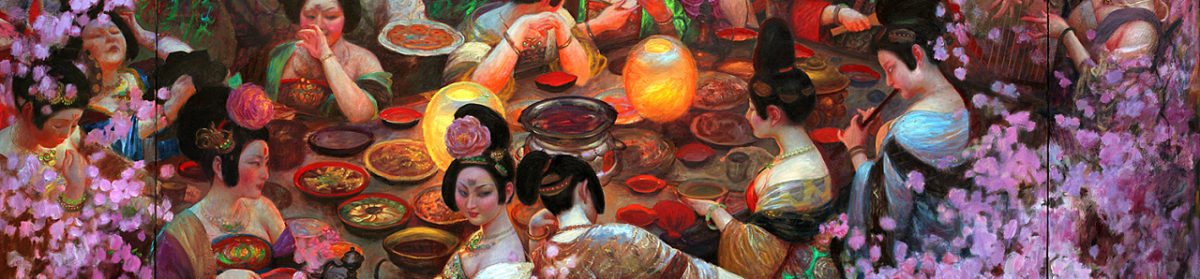
O Soul, go not to the West
Where level wastes of sand stretch on and on;
And demons rage, swine-headed, hairy-skinned,
With bulging eyes;
Who in wild laughter gnash projecting fangs.
O Soul, go not to the West
Where many perils wait!
O Soul, come back to idleness and peace.
In quietude enjoy
The lands of Jing and Chu.
There work your will and follow your desire
Till sorrow is forgot,
And carelessness shall bring you length of days.
O Soul, come back to joys beyond all telling!

Poem calling back the soul of the dead, 3rd century BC, from The Great Summons translated by Arthur Waley in Morris, I. (ed.), Madly Singing in the Mountains: An Appreciation and Anthology of Arthur Waley, Harper Torchbooks, New York, 1970.

Victoria and Albert Museum: http://www.vam.ac.uk/content/articles/b/burial-customs-china/

There’s at least one “ask” in my inbox – which I am researching, I promise! But in the meantime, have some cool poetry. 😀