
Service
China (Southern Song or Yuan Dynasties), 13th-14th century
The Metropolitan Museum of Art
I’ve been looking at feastware lately. These aren’t Tang, but they’re still gorgeous.
Information and Musings on C&I and Research in the SCA
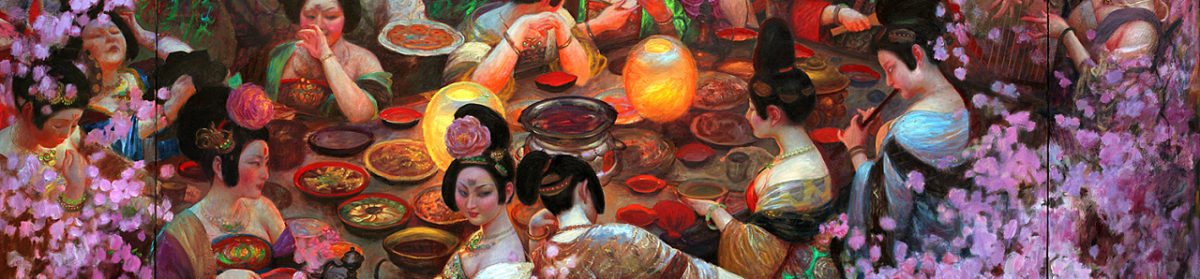
Service
China (Southern Song or Yuan Dynasties), 13th-14th century
The Metropolitan Museum of Art
I’ve been looking at feastware lately. These aren’t Tang, but they’re still gorgeous.


A quick and too brief summary on strap skirt.
And no.4 was prettier than all the others because those were
photos of a merchandise while the others were experiment records.
Please correct me if you find any mistakes. Thank you.?
Reblogging for later reading…
Seven Medieval Christmas Traditions – Medievalists.net
Just some light reading. Enjoy your holiday! <3
Als I lay on Yoolis Night,
Alone in my longynge,
I thought I saw a well faire sight,
A maid hir child rockynge.
Lullaye, lullaye, lullaye, lullaye,
My dere moder, synge lullaye.
The maiden wolde withouten song,
Hir childe aslepe to brynge.
The Childe, he thought she did him wrong,
And bade his moder synge.
Lullaye, lullaye, lullaye, lullaye,
My dere moder, synge lullaye.
“Synge, now, Moder,” sayed the Childe,
“Of what shalle me befalle,
Hereafter, when i cum to eld,
For so don modres alle.”
Lullaye, lullaye, lullaye, lullaye,
My dear moder, synge lullaye.
“Ich moder truely,
That can hir cradle kepe,
Is won to lullen lovely
And singen hir childe aslepe.”
Lullaye, lullaye, lullaye, lullaye,
My dear moder, synge lullaye.
“Swete moder, faire and fre,
Sithen that it is so,
I pray thee that thou lullen me,
For so don modres alle.”
Lullaye, lullaye, lullaye, lullaye,
My dear moder, synge lullaye.
“Swete sonne,” sayed she,
“Whereof shoulde I synge?
Wist I never yet more of thee
But Gabriele’s gretynge.
Lullaye, lullaye, lullaye, lullaye,
My dear moder, synge lullaye.
"He grete me godely on his knee
And sayed, "Oh, hail Mary!
Hail, full of grace. God is with thee,
And beren thou shalt Messye.”
“likely be required, or requested, to wear dresses, due to it being period for females.”
First of all, I kind of want to give the stink eye to whomever told you that. Because I don’t see it as accurate at all.
You need to be comfortable in whatever you decide to adorn yourself with – whatever region, time period, persona, culture – I don’t care. YOU need to be comfortable, otherwise why wear it?
As you go “further” in the SCA – meaning, the longer you are in – it is generally perceived that your kit (fighting kit, garb, feast gear, whatever) should improve. I have been in the SCA just over 4 years (5 in April 2016), and I am nowhere near where I want to be in terms of my kit. Will I ever be 100% spot-on period? Probably not. But I would still like a nice day camp set up and decent kit for feast.
All that being said, there is nothing and nobody shouting down from the heavens saying you HAVE to wear dresses, even with a female persona. There is plenty of evidence of cross-dressing throughout period (the church had lots of OMG DON’T DO IT which means SOMEONE was doing it), and in some areas/periods (like Tang Dynasty China) females wearing male clothing wasn’t a big deal.
Alternatively, you could also have a male persona. Or an alternate persona that is male. Like, say Rhoswen Vihjalmsdottir is your main persona, you could also have Ragnar Vihjalmsson as her brother. But honestly? Do whatever you want. Don’t feel like you have to divide who you are (with personas) in order to be comfortable.
Just be comfortable. Wear what you want. Cultivate a support network within the SCA so that if someone gives you guff, you can lean back on people who love you – and those people will give the guff-givers the stinkiest of eyes and the firmest of talkings-to.
But you asked for information, and so information I will give you. <3
Transvestite Knights: Men and Women Cross-dressing in Medieval Literature
(full text viewable online for free)
Kerkhof, D.L.
(2013)
Faculty of Humanities Theses
(Master thesis)
Abstract: My thesis looks at cross-dressing knights in medieval literature and tries to answer why cross-dressing was common in literature while in reality, cross-dressers were seen as sinful. I look specifically at Ulrich von Liecthtenstein’s “In the Service of Ladies”, Malory’s “Le Morte d’Arthur”, “Berengier au Long Cul”, Dietrich von der Glezze’s “Der Borte”, Heldris of Cornwall’s “Le Roman de Silence”, and “Yde et Olive”. A number of historical sources are also studied in order to understand the medieval literature. The importance of intention as well as what kinds of clothes were worn to cross-dress and how the different genders were viewed is also discussed.
Early, Erotic and Alien: Women Dressed as Men in Late Medieval London
(check your library for full text)
History Workshop Journal (2014)
doi: 10.1093/hwj/dbt046
Judith M. Bennett and Shannon McSheffrey
Abstract:
Cross-dressing by premodern women is often viewed as practical and instrumental (for example, women dressed as men to get jobs or to travel), while modern women’s donning of male garb is usually interpreted as expressing contemporary queer identities. This article introduces a more flexible view of female cross-dressing in the distant past, using the cases of thirteen women cited for such activities in London records between 1450 and 1553. These cases are placed within both the broad context of European practice before the eighteenth century and the specific context of cross-dressing women in premodern London itself. The article argues, first, that cross-dressing by women is not a recent phenomenon, but instead has a scattered but fairly continuous history that stretches back centuries. Second, the article shows that female cross-dressing could be as playful and erotic as male cross-dressing; most of the eroticism of female transgressive dress was, however, linked to prostitution and male erotic desires. Third, it explores how London authorities sought to distance themselves from the perceived vice of female cross-dressing by characterizing the practice as foreign to their City and its culture. The appendix includes a full listing of all known cases of cross-dressing in London before 1603.
Le Roman de Silence
Heldris of Cornwall, first half of the 13th Century
Summary: The story is set in England, and starts with the king decreeing that only boys can inherit property. The nobles get mad, and Lord Cador of Cornwall and his wife decide to name their daughter “Silentius” and raise her as a boy. Years later Nature shows up and gets into a fight with Silentius because she’s really GOOD AT BEING A BOY so much so that all the young eligible ladies are falling in love with her.
Facing page translation English/French: [Amazon] [Worldcat]
Kaydian Bladebreaker’s Court Barony backlog is done!

Ahem. Sorry about that.
Sir Kaydian’s barony is the companion piece to his lovely lady’s, Mistress Cassandra, given at the same event. I was very honored to be asked to take care of these backlog scrolls. They took me awhile (as is evident by the distinct skill-evolution between Cassandra’s and Kaydian’s, especially in terms of script) due to moving twice and the general stuff of life, but they’re done now, and soon I will be shipping Kaydian’s scroll so that they can be matted and framed and (I assume) displayed side by side. Both of them are based on the Visconti Hours – Kaydian’s is LF 155 and Cassandra’s is LF 153.
I wanted to take a moment and show how I prep scrolls for mailing, in addition to showing this pair side by side (which is why I haven’t blogged about Cassandra’s yet). Pics and more after the break!
My mother used to say “I don’t know the answer to that, but I know where to find it!”
(She was a librarian.)
So, no, I don’t have any references for Japanese names – but I know where to find them! 😀
The lovely heralds over on Facebook’s SCA Heraldry Chat group reccommend the following:
Name Construction in Medieval Japan
From the vendor: Written by “Solveig Throndardottir” (aka Dr. Barbara Nostrand), a large compilation of historical Japanese names – forenames, surnames, nicknames, their meanings, and the appropriate Japanese ideographs.
[Link]
I also found some web resources which might be helpful.
”Japanese Names” on An Online Japanese Miscellany, by Nihon Zatsuroku
[Link]A list of pre-1600 Japanese name resources
by Issendai (who appears to be a SCAdian…)
[Link]
A Long History of Japanese Names, Part II: [Link]
For clothing….
The Costume Museum (Kyoto) – Heian Period: [Link]
History of the Kimono, Part II, Nara and Heian: [Link]

I’m home, rested, and decompressed from Magna Faire this weekend, so I thought I’d take a moment and write down a few thoughts.
You know when you get that feeling when you meet new people and see their work and you’re just in awe, and then you take a step back and breathe and can only say to yourself, “Wow, Self. You really need to step it up because damn.” You just get SO INSPIRED by the talent and abilities of others that you just want to keep pushing yourself to do more. To do better.
Stagnation is death. Never be comfortable. Keep climbing. Keep pushing. Do the thing.
<3


Painted Shields! Painted Shields! PAINTED SHIELDS!!!!
15th Century German ‘Pavise’, gesso painted on top of canvas (or stretched and dried hide on a couple, the docents weren’t sure) covered wood shields.
At the Royal Armouries in Leeds, England.
More photos from the Museum and Leeds here: https://goo.gl/photos/YZvjjHFzFmisHHf58


