Continuing on with October-themed goodness, have a translation of The Hammer of Witches (1486), the most infamous book on witch-hunting.
Happy October! 😀
Information and Musings on C&I and Research in the SCA
Continuing on with October-themed goodness, have a translation of The Hammer of Witches (1486), the most infamous book on witch-hunting.
Happy October! 😀

nypl:
Alice in Wonderland turns 150 this fall, and NYPL is
celebrating with a major exhibition—and, of course, with book
recommendations. Read More ›
I know it’s not SCA-related, but I don’t care. 😀

oAdd MS 35313, f. 158v, from the British Library, c. 1500.
The Three Living and the Three Dead, or the Three Dead Kings, is a poem dating back to the 13th century. It, or imagery from it, is often used to open the Office of the Dead in books of hours. Perhaps because medieval skellimans are pretty cool.
You can read the poem in Middle English, with footnotes.
You listen to the poem (after a longish intro).
You can read the British Library’s blogpost on the poem and the imagery in manuscripts.
Happy Fall!

Jacopo Ligozzi
Barbary Moor With a Giraffe
Italy (c. 1580s)
Tempera on Paper, 278 x 218 mm.
[source]
Have I mentioned lately that you should follow medievalpoc? Go do it. Now.

Jacopo Ligozzi
Barbary Moor With a Giraffe
Italy (c. 1580s)
Tempera on Paper, 278 x 218 mm.
[source]
Have I mentioned lately that you should follow medievalpoc? Go do it. Now.

The everyday mind: that is the way.
Buried in vines and rock-bound caves,
Here it’s wild, here I am free,
Idling with the white clouds, my friends.
Tracks here never reach the world;
No-mind, so what can shift my thought?
I sit the night through on a bed of stone,
While the moon climbs Cold Mountain.
-Verse 23, Words from Cold Mountain, Han-Shan, 9th century
(This isn’t necessarily the verse in the painting – it’s just a verse I like.)
From Wikipedia:
Hanshan (Chinese: 寒山; pinyin: Hánshān; literally: “Cold Mountain”, fl. 9th century) was a legendary figure associated with a collection of poems from the Chinese Tang Dynasty in the Taoist and Chan tradition. No one knows who he was, or when he lived and died.
You can read Words from Cold Mountain translated into English here: [Poetry in Translation]
There is also a graphic novel. 😀 [Find it in a library near you!] [Painting: Hanshan and Shide (寒山拾得圖) Yintuoluo (因陀羅, late Yuan dynasty), Yuan Dynasty (1271-1368)]

The everyday mind: that is the way.
Buried in vines and rock-bound caves,
Here it’s wild, here I am free,
Idling with the white clouds, my friends.
Tracks here never reach the world;
No-mind, so what can shift my thought?
I sit the night through on a bed of stone,
While the moon climbs Cold Mountain.
-Verse 23, Words from Cold Mountain, Han-Shan, 9th century
(This isn’t necessarily the verse in the painting – it’s just a verse I like.)
From Wikipedia:
Hanshan (Chinese: 寒山; pinyin: Hánshān; literally: “Cold Mountain”, fl. 9th century) was a legendary figure associated with a collection of poems from the Chinese Tang Dynasty in the Taoist and Chan tradition. No one knows who he was, or when he lived and died.
You can read Words from Cold Mountain translated into English here: [Poetry in Translation]
There is also a graphic novel. 😀 [Find it in a library near you!] [Painting: Hanshan and Shide (寒山拾得圖) Yintuoluo (因陀羅, late Yuan dynasty), Yuan Dynasty (1271-1368)]

A Dead Turtle Dove in a Nest, Ms. Ludwig XV 4, by unknown creator, France ca. 13th century via J. Paul Getty Museum on Wikimedia Commons, Public Domain
#Blankfodder

A Dead Turtle Dove in a Nest, Ms. Ludwig XV 4, by unknown creator, France ca. 13th century via J. Paul Getty Museum on Wikimedia Commons, Public Domain
#Blankfodder

Tang Dynasty (618-907) Bibliography
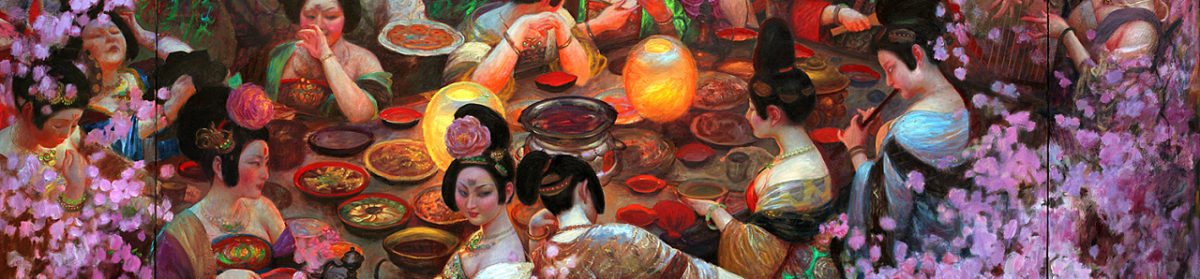
(Don’t mind the pic. We took our color schemes from ponies, because of reasons.)
Benn, C. (2010). China’s golden age: everyday life in the Tang dynasty. Oxford: Oxford UP, 2004.
[Link]This was a great all-over source for me, especially since I didn’t want to just “do the outfits.” I would consider this a must-have for Tang Dynasty research.
Bonds, A. B. (2008). Beijing opera costumes: The visual communication of character and culture. Honolulu: University of Hawaii.
[Link]This was interesting, but not super helpful for Tang. The appendix with garment diagrams, especially the pleating, was the only thing I used this for. It may be useful for other time periods, with the caveat that this is a modern stage interpretation of historic garments.
H. C. [user25056]. (2014, May 3.) How to wear a traditional Chinese garment called ‘Quixiong Ruqun’[Video file]. Retrieved from https://www.youtube.com/watch?v=fGSylLPJ42o
I’m not sure if I would have figured out how the skirt works if I hadn’t seen this video.
Johns, J. (4 June 2011). China’s disappearing clothing. We Drive East. Retrieved from: https://wedriveeast.wordpress.com/2011/06/04/chinas-disappearing-clothing/
This blog of a Fullbright scholar is centered on the history of Chinese breast-binding, but as I can’t read Chinese, her summaries of Chinese sources describing the evolution of undergarment was invaluable.
Ling, S. (14 Dec 2012). More on the Hezi (Undergarment). Dressed up dreams. Retrieved from http://dressed-up-dreams.blogspot.com/2012/12/more-on-hezi-undergarment.html
More interesting information about the Hezi – take with a grain of salt.
Ling, S. (22 Nov 2012). (An extremely long post on) Tang costume history. Dressed up dreams. Retrieved from http://dressed-up-dreams.blogspot.com/2012/11/an-extremely-long-post-on-tang-costume.html
Overview of Tang Dynasty clothing. Not many sources cited.
Mei, H. (2011). Chinese clothing. New York: Cambridge University Press.
[Link]This is a pretty slim volume, and she takes a lot from 5000 Years. Still, the information is good, if brief.
Ministry of Culture, People’s Republic of China. (2003).Secrets of Women’s Underwear in Ancient China. ChinaCulture.org. Retrieved from http://www.chinaculture.org/gb/en_artqa/2006-08/04/content_84371_4.htm
I’m not sure what to think of these little articles – you get no sense of real authorship. Still, the information is in line with what I found elsewhere.
Ravenfea (18 Jun 2010). Ramie fabric – the new (old) linen? Ravenfea: Maker of various fabric things.Retrieved from http://raevenfea.com/learning/ramie-fabric-the-new-old-linen/
Overview of linen vs. ramie.
Shaorong, Y. (2004). Traditional Chinese clothing: Costumes, adornments and culture. San Francisco: Long River Press.
[Link]
This is even slimmer than Mei’s book, but it goes garment by garment, so it’s helpful regardless of time period.
Vainker, S. (2004). Chinese silk: A cultural history. Newark, NJ: Rutgers University Press.
[Link]This was an invaluable source for me when it came to materials – it has lots of amazing photos of extant fabrics, and some great discussion about what weaves, colors, and techniques were used.
Zhou, X. & Gao, C. (1987). 5000 Years of Chinese costume. Tsui-Yee Tang (Ed.) Hong Kong: China Books and Periodicals.
[Link]If I could only own one book of this list, 5000 Years would be it. It’s huge, it’s got lots of great reproduction diagrams of outfits along with period illustrations, and it covers pretty much everything. I focused on Tang, but it has sections for each time period. It can be spendy, but I had success with interlibrary-loan.
If you’re interested in my overview/construction notes – I’ve got them right here.