I want a high fantasy movie where everyone talks with Southern US accents instead of British ones.
The Dwarves though, they can get Minnesotan accents.
ok but picture this: elves with brooklyn accents
“Hey HEY I’m castin’ here, what’d’you – listen, my pop and I serve the Great Tree goin’ back six hundred fuckin’ years so if you got a problem with our fuckin’ magic you don’t fuckin’ come down here into our fuckin’ grove to gimme shit about it.
“Right? You don’t see me fuckin’ goin’ into your shitty man-stables and tellin’ you how to milk horses, do ya? So instead you come down here, disrespect me, disrespect my pa, and how ‘bout you stop fuckin’ disrespectin’ the Great Fuckin’ Tree that grew whens’t the world was young and carries all our fates ‘n its boughs, okay?
“I said, ‘okay?’
“Okay, now fuck off.”
“Oh, ya, my clan’s been mining these ranges for 500 years, real nice place, real friendly. We make a mean hot dish, too, don’t cha know”
“Now, see, our main export may be iron, but y’see, we’re also the home of one of the modern wonders of merchantry and architecture…. THE GREAT DWARVEN BAZAAR. Four subterranean levels, all shops, biggest in the land! Full of tourists but we’re all here for a good time and we’re all for boostin’ the local economy!”
Have at it, my Dear Silly Scadian Shenanigan-Schemers.
hear me out: all-female remake of lord of the rings
hear me out: all-female racially diverse remake of lord of the rings
Isn’t 2 humans, an Elf, 4 Hobbits, a Dwarf and a celestial being in a corporeal form already racially diverse?
Well, at least in how most high fantasy uses the word “race.”
No.
If every fantasy race is imagined as entirely white it absolutely does not count as racial diversity. The implications of a world where every race (or every race that matters) is white are quite the opposite, in fact, and point to conscious or unconscious white supremacy.
feel free to re-imagine the characters as any race you want, but please understand that, in context, tolkien’s characters (almost) all being canonically white does not “point to conscious or unconscious white supremacy”
you see, tolkien’s mythology was intentionally written as stories for the english people. they had no mythology of their own – all of “their” stories had originated from other cultures. middle earth originated as an alternate history of europe (especially england) as it may have been told from an ancient english mythological perspective.
as the professor himself wrote:
“I was from early days grieved by the poverty of my own beloved country: it had no stories of its own … Do not laugh! But once upon a time (my crest has long since fallen) I had a mind to make a body of more or less connected legend, ranging from the large and cosmogonic, to the level of romantic fairy-story… which I could dedicate simply to: to England; to my country.”
“I am historically minded. Middle-earth is not an imaginary world… The theatre of my tale is this earth, the one in which we now live, but the historical period is imaginary.”
people from europe, are, of course, mostly white, so it naturally follows that the people living in an alternate history of europe would be white – as well as the fantasy creatures borne out of european mythology. including a lot of non-europeans in it would make no more sense than native american mythologies featuring white people, or japanese mythologies featuring black people, and so on.
basically, middle earth = europe, southern areas = africa, and eastern areas = asia. there are poc in tolkien’s arda but most (not all) come from places outside middle earth, which makes sense when you put it in a real world context.
diversity in fantasy is great, but please do not assume that everything that does not meet your criteria of diversity is automatically racist. thank you
When I die, they’re going to be doing the autopsy and find out that the cause of death is a bleeding stomach ulcer that, upon close inspection, actually is text that reads out the commentary directly above my own here.
“which makes sense when you put it in a real world context”
The degree to which pre-modern Britain included people of African origin within its population continues to be a topic of considerableinterest and some controversy. Previous posts on this site have discussed a variety of textual, linguistic, archaeological and isotopic
evidence for people from the Mediterranean and/or Africa in the British
Isles from the Late Bronze Age through to the eleventh century AD.
However, the focus in these posts has been on individual sites, events
or periods, rather than the question of the potential proportion of
people from Africa present in pre-modern Britain per se and how
this may have varied over time. The aim of the following post is thus to
briefly ponder whether an overview of the increasingly substantial
British corpus of oxygen isotope evidence drawn from pre-modern
archaeological human teeth has anything interesting to tell us with
regard to this question.
The following post offers a map and brief discussion of the Islamic gold
coins of the later eleventh and twelfth centuries that have been found
in England and their context. Whilst clearly rare finds, there are now
ten coins of this period known, all but one of which are thought to most
probably have their origins in Spain. Moreover, these coins are
considered to be the survivals of a potentially substantial body of this
material present in England at that time.
The aim of the following post is to offer a draft look at an interesting
Arabic account of early medieval Britain that appears to have its
origins in the late ninth century. Despite being rarely mentioned by
British historians concerned with this era, this account has a number of
points of interest, most especially the fact that it may contain the
earliest reference yet encountered to there having been seven kingdoms
(the ‘Heptarchy’) in pre-Viking England and the fact that its text
implies that Britain was still considered to be somehow under Byzantine
lordship at that time.
The following short note is based on a narrative preserved in the eleventh-century Fragmentary Annals of Ireland that
tells of a Viking raid on Morocco in the 860s. This raid is said to
have led to the taking of ‘a great host’ of North African captives by
the Vikings, who then carried them back to Ireland, where they
reportedly remained a distinct group—’the black men’—for some
considerable period of time after their arrival.
Edwards, Paul, and James Walvin. “Africans in Britain, 1500-1800.“ The African Diaspora: Interpretive Essays. Edited by Martin L. Kilson and Robert I. Rotberg. Cambridge, MA: Harvard University Press, 1976: 173-204.
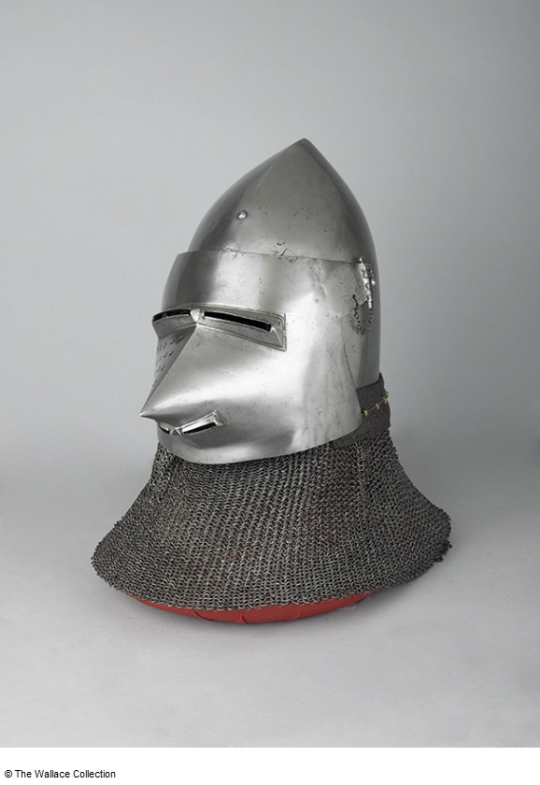
What type of helm should I look for as a 14th century English fighter or 12ty century Norman for heavy fighting?
Anonymous
I had to reach out to some martial types for this answer.
Master Sir Edwin AtteBridge says, “Twelfth century, the famous “norman” conical helm with nasal that we’re all officially wearing in the SCA. 14th century generally bascinet, although kettle hat is also appropriate (but less popular because of SCA handicaps). Inbetween, slowly-evovling “barrel” or “bucket” helms. Basically they took the norman design, started adding a faceplate and covering more of the head, simplifying the construction while they were at it, and when they were done realized that the pointed top they had started with was a better design and went back to an improved version of it. The 13th century is full of dead ends like that.”
“Spotlight: The 14th Century Bascinet” by Alexi Goranov MyArmory.com: [link]
Wikipedia entry: [link] – be sure to look at the Notes and External Links
Image from the Wallace Collection: [link] Visored bascinet Unknown Artist / Maker Milan, Italyc. 1390 – c. 1410 Low-carbon steel, air-cooled, copper alloy and leather Height: 26 cm Width: 37.4 cm, beak to back of skull Weight: 2.005 kg, without visor Weight: 0.82 kg, visor Weight: 1.24 kg, aventail Label: Royal Archaeological Society label marked 25 in ink A69European Armoury I
I reached out the the SCA Garb group on Facebook for more information about the Irish Overdress and a little bit of an SCA History lesson.
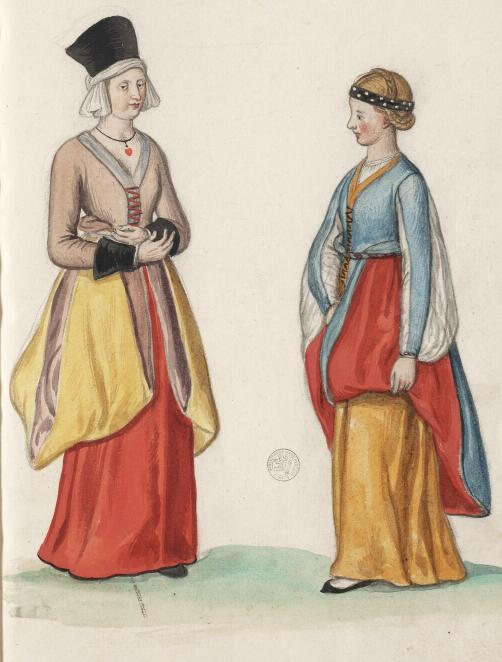
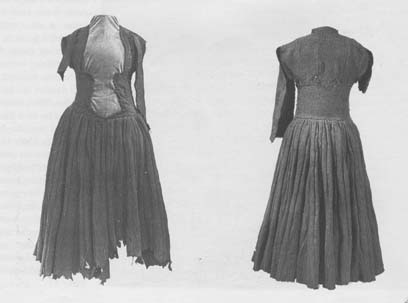
First of all, the proper name for the “Irish overdress” is a Shinrone gown, which dates from the 16th century. Reconstructing History has a pattern [link].
Some of the bits of the history lesson are quoted below. I have removed names, since the group is closed.
“’Irish Overdress’ was a RenFaire misinterpretation of some of Lucas De Heere’s prints of Irish Women which was adopted and stuck because there was so little to go on and so little research into Irish clothing. The Shinrone gown has some similarities in appearance but is of a much more complicated construction.”
One such print by Lucas De Heere.
Shinrone gown
Lady Sorcha Dhocair inghean Ui Ruairc’s packed on Irish women’s garb: [link]
A note on drawstrings and pleated sleeves as relates to the leine: [link]
The Honourable Baroness Ceara Shionnach of Burbage House’s information on Irish clothing: [link]
I feel it is important to mention that the “history lesson” part of the discussion included points that one should wear what makes one comfortable, how the SCA culture has changed in regard to authenticity, and not scary new people away. If you want to throw together some garb that can do double duty at RenFaires and SCA, or if you’re trying to stock your Gold Key with something quick and easy, then the “Irish Overdress” that’s available in commercial patterns easily found at your local craft store will work. If you want to portray a 16th century Irish woman, maybe do some more research.
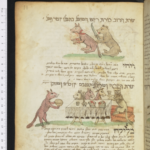
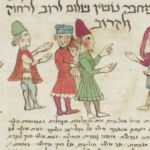
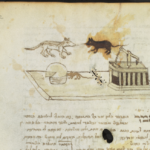
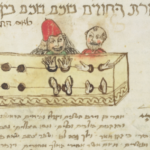
This is Meshal haQadmoni, a book of animal fables written between 1281-1284 by Yitzhaq ben Shlomo ibn Sahula, a Sephardi writer, poet, and Qabbalist from Guadalajara (although this copy was clearly written in Germany at a later date). There’s an English translation of Meshal haQadmoni but it’s unfortunately not online… The first one is labelled “The Bear beheads the Fox,” the second on that page is “The Lion and his friends celebrate, eating and drinking,” etc.
What a fun manuscript! I wonder if anyone has done a study of the iconography?