On
this day in 705, Wu Zetian, the only sovereign empress of China, died
aged 81. Born during the Tang dynasty, she entered the court of Emperor
Taizong as a concubine when she was 14 years old. After Taizong’s death,
the new emperor Gaozong defied custom and chose the well-educated Wu to
remain as his favourite concubine. She rose to become Gaozong’s empress
in 655, after eliminating the current empress by allegedly killing her
own child and framing the empress. The new empress quickly silenced the
elder statesmen who opposed her position on the grounds that she did not
hail from the established aristocracy, with critics exiled and, often,
executed. Emperor Gaozong was a sickly man, and frequently entrusted
affairs of state to Wu, who managed imperial business essentially
single-handedly. Wu was a capable leader, known for her sound
management, her decisiveness, and her ruthlessness; these attributes won
her the respect, and fear, of the Chinese imperial court. Her greatest
accomplishments included agricultural and education reform,
stabilisation of the imperial bureaucracy, and imperial expansion. Upon
Gaozong’s death in 683, his son by Wu ascended to the throne, but,
concerned by the machinations of his ambitious wife, Wu had him exiled
and installed her other son as emperor. In 690, when she was 65 years
old, the empress claimed the throne for herself, and ruled as a
sovereign empress for 15 years. The question of succession led Wu to
designate her exiled son as heir, rather than choosing a member of her
own family, thus ensuring the continuation of the Tang dynasty. In 705,
senior officials conspired to compel the aging Wu to yield power to her
son. She accepted their demands and retired from the throne, dying in
December of that year. Despite decades of condemnation as a vicious
usurper, the achievements of Empress Wu Zetian, who defied the gender
conventions of her day, are increasingly being acknowledged.
Note: [If you have not done so already, check out last week’s lesson. Visit “Viking History” on my blog to view all of the lessons.]
Komiði sæl og blessuð, vinir,
We have already seen that “Vikings” were incredibly crafty, but now we shall focus on their actual art form. Their art was not like our standard for art today (though, that standard, in all honesty, can be rather low). By that, I mean to say that they did not simply “waste” their creation by sticking it on a wall. They used their art, and, in some ways, their art made those objects more powerful.
Art may not seem to be important when studying the “Vikings,” but classifying art still has its importance. One benefit of this practice is that it helps establish a chronology. Yet, most importantly, art and artistic styles show us their mentality and influences – who they interacted with and took inspiration from. Their art tells a story, one that was originally inspired by Celtic art, but then moved to a “Scandinavian” style, until eventually integrating Christian elements. Art tells a story as we trace it through time.
My conversation of each art style will be rather basic, with at least one example for each style. This is not meant to be a cohesive study on the matter, but a general insight into their art. Before we begin, I would like to mention that “Zoomorphic Art” is a form of art that uses animal-like forms and motifs. Also, this lesson is more focused on the images than on textual explanation. Do not worry yourself with remembering the subtle differences between styles. If anything, just enjoy the interesting, lavishly decorated objects.
As a zoomorphic art form, animals are a common motif for this style. This style, the earliest of the “Viking” set of art forms, reveals gripping beasts with triangular, tapered bodies. The space in which they art filled was full, leaving very little empty space. This results in very elaborate and detailed artwork.
Example:
Oseburg Ship Detail (from where one name for the style originates):
“Borre” Style
Date Range: ca. 850 – 970.
This style was the most Scandinavian in nature. It was also the most widely spread. This style rises alongside the very height of the Viking Age, and thus gives us no surprise that it is the most Scandinavian and widespread of the art styles we are discussing. It was also the last fully pagan period for their art style.
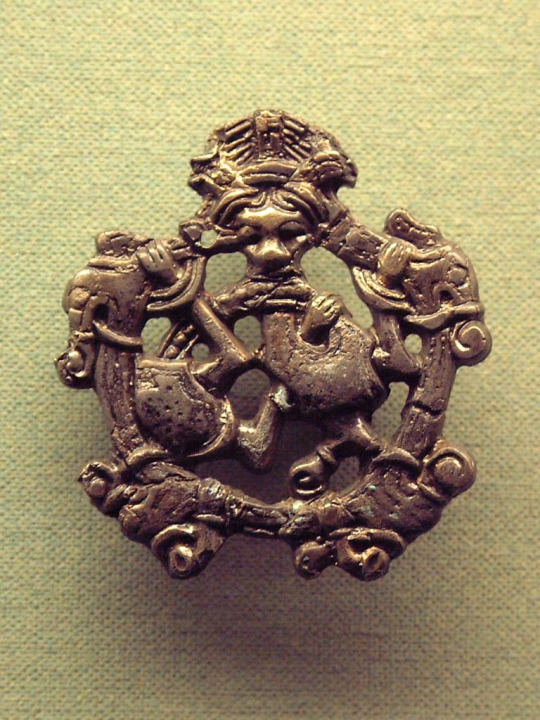
This style features tightly interlaced, ribbon like beasts, often singular and without multiple other animals lacing around it (but not always). These animals had pretzel-shape, or ribbon-like, bodies.
Example:
Bronze Pendant from Hedeby:
Jelling Style
Date Range: mid-10th century.
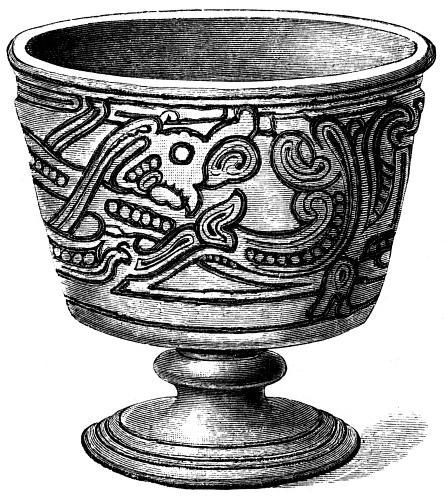
This art style, emerging during the early phases of Christianization in Scandinavia, features ribbon-like animals. Unlike the Borre style, these animals have “S” shapes, versus the pretzel shape. This style is much more spacious and open than previous ones.
Example:
King Gorm’s Cup, ca. 958:
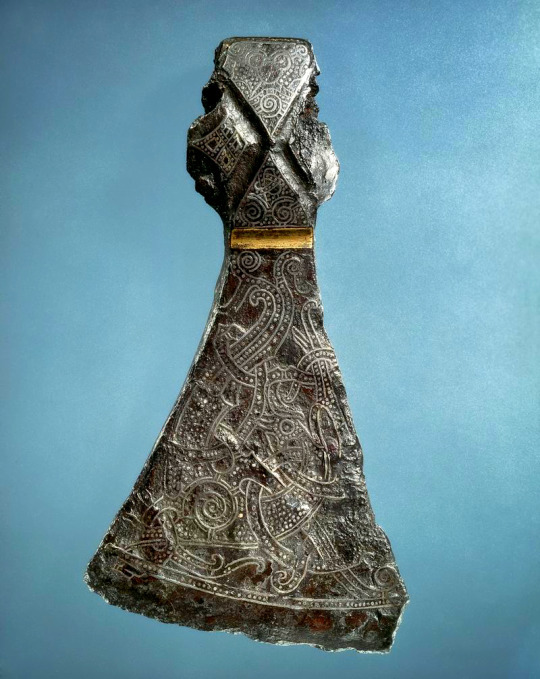
Mammen Style
Date Range: late 10th century.
This style still features ribbon-like animals (this aspect really sticks, doesn’t it?), yet the bodies of these animals are much more substantial. They are filled with figures twisting around. By this time, Christian motifs had begun to work their way into the styles, such as the motif of the lion and the snake.
Examples:
Mammen Axe:
Jelling Stone (still Mammen, just located at Jelling):
Ringerlike Style
Date Range: ca. 990-1050.
This style is very similar to Mammen, but tighter and featuring more tendril designs. As earlier styles had Celtic influence, this style has more Anglo-Saxon influence (partly due to their experience abroad in places featuring these styles, such as England). This style truly demonstrated the syncretism between the Scandinavian pagan styles and the new Christian styles they were incorporating. Thus, this art reveals some of the first patterns for consistent evidence of conversion. Of course, not all works of the Ringerlike Style were Christian.
Example:
Sigurðr Runestone:
Urnes Style
Date Range: 1040-1110.
Many may criticize this style curly because it was the least “traditional” of the Viking styles. By that I mean to say it was the most influenced by Christian elements. Yet, it is foolish to reject such a beautiful style for such petty reasons, for this style is a careful blend; one does not conquer the other. For this is truly the final phase of Viking art.
This style features intricate animals interweaving, as we have seen throughout these styles. The animals have chunky bodies, as we began to see in the Mammen style. Everything is curvy and asymmetrical, balancing instead around a system of thinly laced ribboning. This style was most often featured in wood carving, especially on stave churches. Yet, runestones and metalwork also featured this style. Romanesque art would replace this (and this is the true shame, I must say).
Example:
Urnes Stave Church Portal (Entrance):
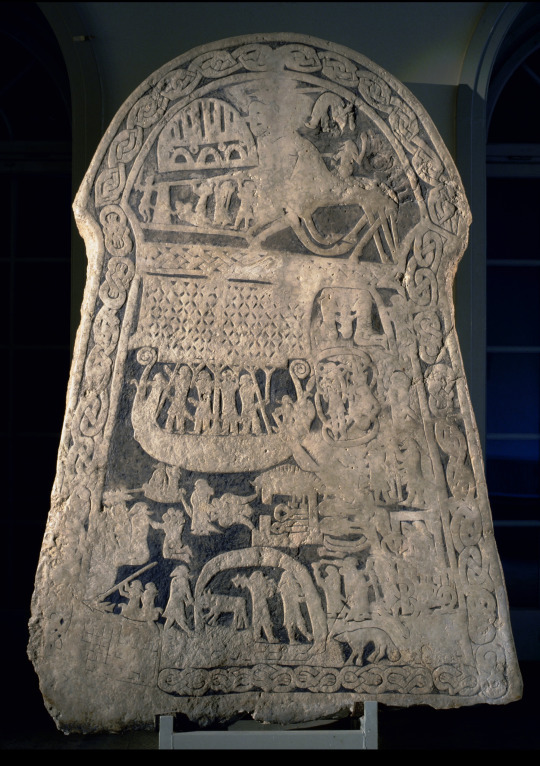
Narrative Art
This post is already terribly long, but I could not possibly leave out this type of art. This art form is essentially storytelling through pictures, as we have actually already seen with the Sigurðr Runestone. The best example of this art form, though, would be the Gotland Picture Stones (dates ranging from the 5th to 11th centuries). The Stone from Ardre is also a good example (seen below), dating from the 8th-9th century. This stone features Óðinn and Sleipnir as well as Þórr. In short, this art form often depicts mythological stories and figures. Yet, these works are also not often very clear. Ships are also extremely popular motifs for this style. Nearly all of these things I have told of the Narrative Art form is seen on the Ardre Runestone:
Wrap-up
In short, there is quite a lot to Viking Art. Yet, as the title of this lesson suggests, every object they placed their art upon had a specific function. Ships, jewelry, cups, axes, storytelling stones, buildings, memorials, and so forth. Art was integrated into life. It was not its own sphere, but rather a natural element of every object. Art gave objects more meaning – more power. They conveyed wealth, culture, and history.
I hope you all enjoyed this lesson!
Skál og ferð vel.
Next Week’s Lesson: Lesson 19 – Viking Warfare.
Sources and Notations:
[Gen.] Jennifer Dukes-Knight, “Crafts, Art, and Weaponry,” Lecture, Viking History, University of South Florida, 2015. || I had little extra input to make this lesson (again), so there are clearly a lack of notations this time. If there is any aspect of this lesson that you would like more detail, send me an ask and I shall research it for you.
[Fig.1] “Oseberg Ship – Detail,” via Maraire on Flickr. (link)
[Fig.2] “Bronze pendant from Hedeby (Haithabu).” by Cassiopeia via Wikipedia Commons. (link)
[Fig.3] “Gorm’s Silver Cup,” via Green, J. R. (1902) A Short History of the English People from the Wikipedia Commons. (link)
[Fig.4] “Viking Axe from Mammen,” via the National Museum of Denmark. (link)
[Fig.5] “Lion Runestone at Jelling,” via Sven Rosborn from the Wikipedia Commons. (link)
[Fig.6] “Sigurdsristningen,” by Ann-Sofi Cullhed via Wikipedia Commons. (link)
[Fig.7] “Urnes Portal,” by Nina Aldin Thune (?) via Wikipedia Commons. (link).
[Fig.8] “Ardre Runestone,” From Ardre Parish, Gotland, Sweden. Now at the National Historical Museum in Stockholm, Sweden. Photo via Wikipedia Commons. (link)
It’s been awhile between posts in this series. Let’s summarize a bit, shall we?
Step One: You have a basic understanding of how to put communicate ideas and concepts in writing.
Step Two: You researched a Thing – who did the Thing, how they did the Thing, what the Thing was for, etc.
Step Three: You did the Thing, taking notes and pictures along the way.
Now you’re ready to share the Thing with others, which means writing up Documentation about the Thing – whether it’s meant to be printed out and sit alongside the Thing in a fair/competition/display or be published on your blog/website.
Getting Started
Documentation can be basic and brief, or it can be long and thorough. I tend to lean toward the latter when I sit down to write documentation. (Notes on the back of scrolls are a little different – I simply cite whatever extant I used as inspiration, the folio, date, and holding institution and call it good – but if I were to enter a C&I piece into a fair/competition, I would do a full write-up. Here’s a scribal-specific template!)
Try your very, very best no to wait until the night before an event to write/finish your documentation. This is the same advice you got when you were told not to wait until the night before to do your homework/write that research paper/etc. For a myriad of reasons, it’s best to get things done with ample time for editing, review, and printing physical copies. I’ve done the late-night dash to a Kinkos the night before an event I traveled several hours to in order to print off my documentation – it’s not a fun dash.
Gather up all your notes, files, pictures, etc. before you start writing. This is where the notebooks, or digital tools like Google Drive or Evernote can come in handy.
Consider this manuscript in light of the article I posted 2 days ago about historical European mixed race families. A lot of similar articles go right from Roman Britain to Renaissance Italy, but documents like this that often bridge the historical “gap” because go unremarked upon because they’re often not considered analgous to written records or artistic depictions. What they do, rather, is show that in the imagination of artists during this time, racial diversity was part of their social consciousness and how they envisioned concepts like “a family”. My thanks to Dr Caitlin R Green on bringing this manuscript to my attention.
A couple of months ago, I threw myself (is there any other way?) into researching period tracing techniques for Western Europe. We talk about how “tracing is period” but generally, the conversation stops there. This was a fun little rabbit hole for me, and someday I’ll trek back down it and try to make my own tracing paper. Though I doubt my husband will be a fan of me spreading fish glue on granite until it is thick enough to make paper…
Forty years old this year, the coconut sketch in Monty Python and the Holy Grail may be one of the most iconic opening scenes in film history. The pillar of chivalry, Arthur, King of the Britons, appears riding an imaginary horse like a child on a playground. His faithful servant, Patsy, accompanies him, banging two coconut halves together to make the sound of the horse’s hooves. Arthur and Patsy are very, very serious about their quest. They are the only ones who are.
The whole scene concentrates on those coconuts. The put-upon straight-man of the film, Arthur, gamely tries to explain the existence of coconuts in medieval England (“they could have been carried”). The grail remains all but forgotten as the guards on the castle walls uproariously tear down his explanations. (“Are you suggesting that coconuts migrate?”)… Audiences are left in stitches and thoroughly convinced of the impossibility of coconuts existing in medieval England.
Except medieval England was lousy with coconuts. No, really, and Monty Python may well have known it.
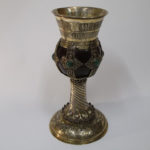
They’re Oxbridge men, after all, and several Oxford and Cambridge colleges still preserve coconuts given to them in the fifteenth century. Here’s a fifteenth-century coconut cup that came to Oxford more recently. While parts of it were added more recently, the original elements are medieval. This is the only medieval English coconut cup currently displayed online, and it shows how the shell was strapped into a goblet form using a harness of silver or gold. The English continued to make coconut cups after the medieval period—in the sixteenth century, seventeenth century, and beyond. They were numerous enough that by the fifteenth century, individual households might boast several coconut cups. One humble esquire highlighted the prestige of these cups when he willed his coconut cup to his heir in tail male, just like the Bennett estate in Pride and Prejudice or the Crawley estate in Downton Abbey.
But why make luxurious golden goblets out of coconuts? And how did they get to medieval England anyway, if swallows didn’t carry them?
In the Middle Ages, coconut palms were not yet as widespread as they are today. Coconuts grew in their native Maldives, in India, and perhaps parts of western Africa and the Middle East. (They were also growing in western Central America, but had gotten there on their own, crossing the pacific like small, tasty boats without a swallow in sight.) Coconuts formed a regular part of commerce across the Indian Ocean from Roman times, and this trade appears to have continued with little disruption straight through the ancient and medieval periods. Given England’s Roman history, it isn’t impossible that Life of Brian-era English might also have had access to coconuts. These coconuts weren’t transported all that way to be made into cups, however. They were imported as medicine.
Beginning regularly once again in the fourteenth and fifteenth centuries, medicinal coconuts arrived in England. This time, they were packed on Venetian galleys along with luxuries from silks to sugar, and next to exotic pets like monkeys and parrots. In turn, the Venetians got the coconuts from Alexandria and from the same trade networks that the coconuts had been part of for millennia.
They were not called coconuts, either. The name “coconut” derives from the Portuguese and dates to the sixteenth and seventeenth centuries-after the medieval period. In the Middle Ages, Europe knew the coconut as the “Nut of India” or “Great Nut.” It was the great, big whopping nut that was transported all the way from India—the only nut large enough to make into a drinking cup.
Officially registering a name is super awesome, so first of all – rock on you for doing it.
To register a name, you will go through your Kingdom’s College of Heralds. You can usually find it on your kingdom’s website, or by searching “<kingdom name> heralds” in Google. There is a form you fill out with basic information, the name you want, and your documentation.
So yes. Yes you have to have documentation. Even if your name is John or Katherine.
A lot of documentation for “common” names can be found on the SCA College of Arms website.
Heraldry/name registration isn’t really a magical, lost art form that requires animal sacrifice and perfectly drawn chalk diagrams. It’s just rule-following, forms, and documentation.
That moment when you click on a link for a book, fully expecting to be taken to an Amazon or University Press page, but instead get a digitized copy with a download link.
So please enjoy Pen and Parchment: Drawing in the Middle Ages, by Melanie Holcomb in conjunction with the Metropolitan Museum of Art.
The MOMA has a lot of books to download, actually. It was just nice to stumble on this one unexpectedly.
Okay, so to start, these are pretty fun. They look like starfish!
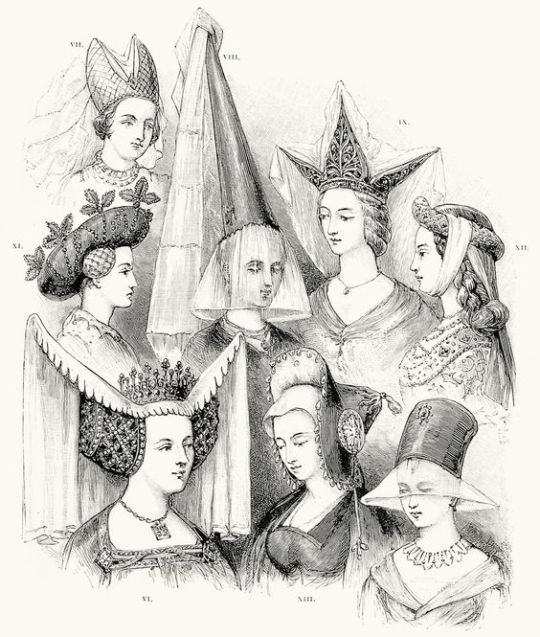
A wild hennin has appeared!
Ahem.
I looked in Google Books for henins*, and the only references to the “triple-horned” variety seemed sketchy – meaning they didn’t have citations. it looks like the origin of this image and concept is from a variety of ladies journals from the 1880s. Yay Victorian myths about 15th century clothing.
But just in case, I reached out to a newly-minted Laurel who is known for her hats. She didn’t know of anything, nor could she find any solid research for this type of hat.
Sorry. 🙁
It looks like we’ll have to keep looking for ideas for 15th century Staryu cosplay.
*Google Book is a great place to start research, by the by, since it searches the full text of a book, whether you can see those scanned pages or not. It helps you refine terms and points you toward possible sources. I kind of adore it.
My hat is off to you as you continue your research into fancy headgear.
Yeah, research into East Asia is difficult because of the language barrier – and that’s just the beginning. Japan should be a little easier than China, though.
So with my initial Google searching, I found this website with a variety of publications written in both Japanese and English, which may be helpful.
My next step would be to look at museum collections.
The Tokyo National Museum has a 14th century pouch that has braided cord: [Link].
The Portland Art Museum had (at one point) an exhibit on Samurai that featured some kumihimo. They cite a book, but also feel free to reach out to the curators for more information: [Link]
Don’t limit yourself to the search term “kumihimo.” It’s translated most often as “braided cord” so don’t be afraid of using that term, especially in western museum collections.
Lastly, connect with other SCAdians who do Japanese crafts. There is a Facebook group for SCA Japanese, so someone there might be able to help.